
Bibliography
Bibliography main page; Theorizing UI; Doing UI;Types of UI; Calls to action; Barriers to UI; Proposed solutions; Funding; Critiquing DI; Who does UI; Where UI is or can be done; Being disciplined
Being Disciplined
These entries provide first-person testimony and self-reports from knowers trying to function within ‘traditional’ (read: Western, Colonial, Supremacist etc.) disciplinary boundaries.
Abel, J. 2021. Nishga. McClelland and Stewart.
Publisher Abstract: As a Nisga'a writer, Jordan Abel often finds himself in a position where he is asked to explain his relationship to Nisga'a language, Nisga'a community, and Nisga'a cultural knowledge. However, as an intergenerational survivor of residential school--both of his grandparents attended the same residential school--his relationship to his own Indigenous identity is complicated to say the least. NISHGA explores those complications and is invested in understanding how the colonial violence originating at the Coqualeetza Indian Residential School impacted his grandparents' generation, then his father's generation, and ultimately his own. The project is rooted in a desire to illuminate the realities of intergenerational survivors of residential school, but sheds light on Indigenous experiences that may not seem to be immediately (or inherently) Indigenous. Drawing on autobiography and a series of interconnected documents (including pieces of memoir, transcriptions of talks, and photography), NISHGA is a book about confronting difficult truths and it is about how both Indigenous and non-Indigenous peoples engage with a history of colonial violence that is quite often rendered invisible.
Categories: Doing UI; Critiquing DI; Being disciplined; Where UI is or can be done
Abel, J. 2023. Empty Spaces. McClelland and Stewart.
Publisher Abstract: Reimagining James Fenimore Cooper’s nineteenth-century text The Last of the Mohicans from the contemporary perspective of an urban Nisga’a person whose relationship to land and traditional knowledge was severed by colonial violence, Jordan Abel explores what it means to be Indigenous without access to familial territory and complicates popular understandings about Indigenous storytelling. Engaging the land through fiction and metaphor, the successive chapters of Empty Spaces move toward an eerie, looping, and atmospheric rendering of place that evolves despite the violent and reckless histories of North America. The result is a bold and profound new vision of history that decenters human perception and forgoes Westernized ways of seeing. Jordan Abel’s extraordinary debut work of fiction grows out of his groundbreaking visual compositions in NISHGA, which integrated descriptions of the landscape from Cooper’s settler classicinto his father's traditional Nisga'a artwork. In Empty Spaces, Abel reinscribes those words on the page itself, subjecting them to bold rewritings and inviting us to come to a crucial understanding: that the land knows everything that can and will happen, even as our world lurches toward uncertainty.
Categories: Doing UI; Being disciplined
Abolmaesumi, P., Black, J., Boyd, Jenkins, C., L. Kong, H., Ramana, M., Reynolds, S., Stack, M., Teves, S., and Troeung, Y-D. 2021. Chromatic: Ten Meditations on Crisis in Art and Letters. Peter Wall Institute for Advanced Studies, UBC.
Publisher Abstract: A collection of essays and illustrations as diverse as the subject of crisis itself. Imagined and brought to life by leading UBC scholars in collaboration with local artists, Chromatic asks what it means to be in crisis and grapples with the personal and societal impacts of crisis during a time of unprecedented global upheaval. Each contributor to this diverse collection takes a profoundly different approach yet fascinating and unexpected connections emerge. The result is a book that juxtaposes gorgeous, colourful artwork with writing that will surprise and challenge you, outrage and enlighten you. From a precise discussion of a nuclear crisis in Japan, to a satirical listicle about corporate academia, to an ICU doctor's poetic response to COVID-19, each contributor to this diverse collection takes a profoundly different approach to writing about crisis, yet fascinating and unexpected connections emerge.
Categories: Doing UI; Calls to action; Types of UI; Being disciplined
de Beauvoir, S. 1949. The Second Sex. Trans. C. Borde and S. Mallovany-Chevallier. Edn. of 2011. Vintage.
Project Abstract: A foundational text of feminist theory in which de Beauvoir explains how women are socially constructed as Others within patriarchal society. In this work, and by drawing from existentialism, phenomenology, sociology, and history, de Beauvoir develops and utilizes a method of feminist inquiry that explored women’s oppression and unfreedom under patriarchy.
Categories: Doing UI; Critiquing DI; Who does UI; Being disciplined
Campbell, M. 2007 "We Need to Return to the Principles of Wahkotowin," in Eagle Feather News 10
Project Abstract: Campbell calls for Indigenous peoples to embody the principle of Wahkotowin, that is, kinship, relationship, and family with all of creation. Campbell laments the loss of this principle within Indigenous communities in Canada, and she points to some examples including the lack of safety and family support for Indigenous children, and the lack of “Indian status” for some Indigenous groups like the Lubicon Lake Cree Nation. Campbell emphasizes the importance of remembering Wahkotowin, especially for safeguarding Indigenous children.
Categories: Calls to action; Doing UI; Barriers to UI; Being disciplined; Where UI is or can be done
Dotson, K. 2012. “How is This Paper Philosophy?” in Comparative Philosophy 3, pp. 3-29.
Author Abstract: This paper answers a call made by Anita Allen to genuinely assess whether the field of philosophy has the capacity to sustain the work of diverse peoples. By identifying a pervasive culture of justification within professional philosophy, I gesture to the ways professional philosophy is not an attractive working environment for many diverse practitioners. As a result of the downsides of the culture of justification that pervades professional philosophy, I advocate that the discipline of professional philosophy be cast according to a culture of praxis. Finally, I provide a comparative exercise using Graham Priest’s definition of philosophy and Audre Lorde’s observations of the limitations of philosophical theorizing to show how these two disparate accounts can be understood as philosophical engagement with a shift to a culture of praxis perspective.
Categories: Critiquing DI; Barriers to UI, Doing UI
English, J. 2008. The Economy of Prestige: Prizes, Awards, and the Circulation of Cultural Value. Harvard University Press.
Publisher Abstract: This is a book about one of the great untold stories of modern cultural life: the remarkable ascendancy of prizes in literature and the arts. Such prizes and the competitions they crown are almost as old as the arts themselves, but their number and power--and their consequences for society and culture at large--have expanded to an unprecedented degree in our day. In a wide-ranging overview of this phenomenon, James F. English documents the dramatic rise of the awards industry and its complex role within what he describes as an economy of cultural prestige. Observing that cultural prizes in their modern form originate at the turn of the twentieth century with the institutional convergence of art and competitive spectator sports, English argues that they have in recent decades undergone an important shift--a more genuine and far-reaching globalization than what has occurred in the economy of material goods. Focusing on the cultural prize in its contemporary form, his book addresses itself broadly to the economic dimensions of culture, to the rules or logic of exchange in the market for what has come to be called "cultural capital." In the wild proliferation of prizes, English finds a key to transformations in the cultural field as a whole. And in the specific workings of prizes, their elaborate mechanics of nomination and election, presentation and acceptance, sponsorship, publicity, and scandal, he uncovers evidence of the new arrangements and relationships that have refigured that field.
Categories: Critiquing DI; Being disciplined; Funding
Fazakas, L., Cussans, J., and Hopkins, C. 2019. Beau Dick: Devoured by Consumerism. Bill Reid Gallery.
Abridged Abstract (from White Columns Gallery): “We talk about the ‘the system’. It has no face; it has no conscience either. So these forces we are up against are almost on the supernatural level. My conscience tells me we have to fight back. And in some ways it is war on another level; nonviolent, but spiritual warfare. It has come to that.” – Beau Dick, 2017. ‘Devoured by Consumerism’ includes a group of some fifteen carved and painted masks and sculptural works made by Dick between 1980 and 2016. The exhibition explores and amplifies the inherent tensions and contradictions between the Kwakwaka’wakw Winter Ceremonies and contemporary consumer culture. Writing about Dick’s intentions for ‘Devoured by Consumerism’ LaTiesha Fazakas suggests: “Through the sharing of works inspired by the Kwakwaka’wakw Winter Ceremonies, Beau Dick hoped to spark change in a world that he saw as devouring itself under the ravenous pressures of capitalism.”
Categories: Calls to action; Doing UI; Barriers to UI; Critiquing DI; Being disciplined
Frankl, V. 1946. Man’s Search for Meaning. Part I Trans. Ilse Lasch. Edn. of 2006. Beacon Press.
Publisher Abstract: Psychiatrist Viktor Frankl's memoir has riveted generations of readers with its descriptions of life in Nazi death camps and its lessons for spiritual survival. Between 1942 and 1945 Frankl labored in four different camps, including Auschwitz, while his parents, brother, and pregnant wife perished. Based on his own experience and the experiences of others he treated later in his practice, Frankl argues that we cannot avoid suffering but we can choose how to cope with it, find meaning in it, and move forward with renewed purpose. Frankl's theory-known as logotherapy, from the Greek word logos ("meaning")-holds that our primary drive in life is not pleasure, as Freud maintained, but the discovery and pursuit of what we personally find meaningful.
Categories: Being disciplined; Theorizing UI; Doing UI
Jenkins, C. 2017. What Love Is and What It Could Be. Basic Books.
Author Abstract: Based on the work of theMetaphysics of Love Project, this book unpicks the conceptual, ideological, and metaphysical tangles that get in the way of understanding what love is. What Love Is And What It Could Be explores different disciplinary perspectives on love, in search of the bigger picture. It presents a "dual-nature" theory: romantic love is simultaneously both a biological phenomenon and a social construct. The deep motivation behind this work is that we have a collective responsibility to figure out romantic love. It is a formidable and potentially dangerous force, its power underwritten by its twin footholds in our biological natures and in our most treasured social practices. Often we pretend that it is incomprehensible and out of control, but this is a way of abdicating our responsibility to understand love and fix it when it's broken. What Love Is And What It Could Be explains that romantic love is currently broken in multiple interlocking ways, but also that we can change this status quo. Once we understand what love is, we will be able to take control of what it could be.
Categories: Doing UI; Critiquing DI; Being Disciplined; Where UI is or can be done
Jenkins, C. 2022a. Sad Love: Romance and the Search for Meaning. Polity.
Author Abstract: What if your happy ever after … isn’t? This book is about sad love. Or, more accurately, it is about eudaimonic love, which has room for the full gamut of human experiences, both “positive” and “negative.” Eudaimonia, in the old sense (older than Aristotle!), was about benevolent spirits. In a contemporary setting, I frame eudaimonia in terms of how we are influenced by the people, environments, communities, and networks around us. As I see it, a proper understanding of eudaimonia demands that we take into account the deep and dramatic implications of our interconnectedness: we find meaning in collaboration and creation, and meaning is what makes life worth living for us. Eudaimonic love is collaborative, creative, and dynamic. It grows and changes. It orients us towards living a meaningful life, but away from the “pursuit of happiness,” including the romantic “happy ever after.” When we centre eudaimonia rather than romance, we can see why sad love is not necessarily a failure condition. Sadness – and other “negative” emotions – can be a legitimate part of a meaningful love story. Sad Love furthers the work of What Love Is in critiquing and dethroning culturally dominant romantic ideologies of love, especially the idea that love is defined by certain kinds of feelings. I have stopped asking how to be happy ever after in love. That question doesn’t interest me anymore.
Categories: Doing UI; Critiquing DI; Being Disciplined; Where UI is or can be done
Jenkins, C. 2022b. “Love as a Gift Economy,” in New Philosopher 35.
Project Abstract: In this essay Jenkins uses Robin Wall Kimmerer’s framework of the Gift Economy to reconceptualize practices of romantic love. Jenkins discusses the capitalist commodification of women’s care, love, attention, and reproductive labour as scarce resources that must be hoarded and controlled, and she explores what it might mean if love were instead construed as a gift, drawing a comparison with a statement made by a rainforest hunter-gatherer, that “I store my [excess] meat in the belly of my brother.”
Categories: Theorizing UI; Barriers to UI; Types of UI; Being Disciplined
Jenkins, C. 2023. Nonmonogamy and Happiness. Thornapple Press.
Author Abstract: The love story we’re all familiar with ends with “ … and they lived happily ever after.” But how often do we hear a nonmonogamous love story with that ending? In all kinds of contexts, nonmonogamous happiness is erased. From the ubiquitous “friend who tried it once and it didn’t end well” to Dan Savage’s long-term jokes about never being invited to a polyamorous third wedding anniversary, we are repeatedly assured that nonmonogamy leads to misery. In “real” love, we are taught to expect the opposite: to expect happiness. When we want to ask if someone’s relationship is going well, we ask if they are “happy with” their partner. We might even ask whether their partner makes them happy. But what does love have to do with happiness? Doesn’t love have space to accommodate the full range of emotional experience? Carrie Jenkins thinks it does, or at least it can. She draws connections between the expectation that love will make us happy and the undue focus on positive emotions to the exclusion of “negative” ones. She argues that love—monogamous or otherwise—might better aim at being eudaimonic than at being happy, and that we have a better chance of achieving this if we are able to make relationship choices free from the prejudices and distortions that lead to an unduly rosy view of monogamy and an unduly miserable picture of the alternatives.
Categories: Doing UI; Critiquing DI; Being Disciplined; Where UI is or can be done
Jenkins, C. and Nappi, C. 2020. Uninvited: Talking Back to Plato. McGill-Queen’s University Press.
Author Abstract: Plato’s Symposium depicts a group of men giving a series of speeches about the nature of love, with themes ranging from religion and metaphysics to medicine and pregnancy. The lone woman in the room, a “flute girl,” is sent away as the discussion turns to serious matters; at the same time, the wisest of the men attributes his theories to a woman, the possibly fictional Diotima. Despite their absence from this important intellectual exchange, women are part of Symposium. What can contemporary feminist readers do with this troubling yet immeasurably influential work? In Uninvited historian Carla Nappi and philosopher Carrie Jenkins talk back to Plato in poetry, inspired by the voices of women who were not permitted to speak in their own lifetimes. Images and ideas from Symposium are refracted through multiple lenses to reveal a tumult of mystical, intellectual, pedagogical, and sexual ideologies. Sometimes beautiful, sometimes horrific, these poems dance within and between the lines of Symposium, carving space for new kinds of conversations about love, with themes ranging from gender and voice to power and violence. Designed to be read with or without prior knowledge of Plato, this book invites the uninvited to join a strange, amorphous, and unending conversation on the nature of love and desire - and on the possibilities intellectual and creative activity can offer.
Categories: Being Disciplined; Doing UI; Critiquing DI
Khan, S. 2022. “Becoming Undisciplined: Disciplinary and Disciplining Norms” in ASAP review.https://asapjournal.com/node/becoming-undisciplined-disciplinary-and-disciplining-norms-sanaa-khan/
Project Abstract: Using excerpts from her personal journal, correspondence with friends, and correspondence with university administrators, Khan explores her experience of being disciplined into following the norms of (colonial) academia and the expectation that she submit to those norms. Khan considers how the process of becoming disciplined is detrimental to her health, and how becoming undisciplined is necessary for her survival.
Categories: Doing UI; Critiquing DI; Barriers to UI; Who does UI; Being disciplined
Keynes, J. M. 1942. “Newton, the Man.” Speech prepared for a tercentenary celebration of Isaac Newton’s birth, at the Royal Society of London.https://mathshistory.st-andrews.ac.uk/Extras/Keynes_Newton
Project Abstract: In this lecture, written for an event marking the tricentenary of Sir Isaac Newton’s death, Keynes challenges the once-dominant conventional characterization of Newton as “the first and greatest of the modern age of science.” Keynes instead describes Newton as not “the first of the age of reason” but as “the last of the magicians.” Keynes’s lecture explores Newton’s inquiries into alchemy and mysticism, and says that Newton only transformed into the “Monarch of the Age of Reason” later in life, through the efforts of Newton’s friends, and following his own nervous breakdown.
Categories: Types of UI; Who does UI; Being disciplined
King, T. 2003. The Truth About Stories: A Native Narrative. House of Anansi Press. Also available asaudio lectures.
Publisher Abstract: "Stories are wondrous things. And they are dangerous." In The Truth About Stories, Native novelist and scholar Thomas King explores how stories shape who we are and how we understand and interact with other people. From creation stories to personal experiences, historical anecdotes to social injustices, racist propaganda to works of contemporary Native literature, King probes Native culture's deep ties to storytelling. With wry humor, King deftly weaves events from his own life as a child in California, an academic in Canada, and a Native North American with a wide-ranging discussion of stories told by and about Indians. So many stories have been told about Indians, King comments, that "there is no reason for the Indian to be real. The Indian simply has to exist in our imaginations." That imaginative Indian that North Americans hold dear has been challenged by Native writers - N. Scott Momaday, Leslie Marmon Silko, Louis Owens, Robert Alexie, and others - who provide alternative narratives of the Native experience that question, create a present, and imagine a future. King reminds the reader, Native and non-Native, that storytelling carries with it social and moral responsibilties. "Don't say in the years to come that you would have lived your life differently if only you had heard this story. You've heard it now."
Categories: Theorizing UI; Doing UI; Being disciplined
Lorde, A. 2020. The Selected Works of Audre Lorde: Edited and with an Introduction by Roxane Gay. W.W. Norton and Company.
Publisher Abstract: A definitive selection of prose and poetry from the self-described "black, lesbian, mother, warrior, poet," for a new generation of readers. Audre Lorde is an unforgettable voice in twentieth-century literature, one of the first to center the experiences of black, queer women. Her incisive essays and passionate poetry-alive with sensuality, vulnerability, and rage-remain indelible contributions to intersectional feminism, queer theory, and critical race studies. This essential reader showcases twelve landmark essays and more than sixty poems, selected and introduced by one of our most powerful contemporary voices on race and gender, Roxane Gay. The essays include "The Master's Tools Will Never Dismantle the Master's House," "I Am Your Sister," and excerpts from the National Book Award-winning A Burst of Light. The poems are drawn from Lorde's nine volumes, including National Book Award nominee The Land Where Other People Live. As Gay writes in her astute introduction, The Selected Works of Audre Lorde celebrates "an exemplar of public intellectualism who is as relevant in this century as she was in the last."
Categories: Calls to action; Doing UI; Types of UI; Critiquing DI; Being disciplined; Where UI is or can be done
Loveless, N. 2019. How to Make Art at the End of the World: A Manifesto for Research-Creation. Duke University Press.
Publisher Abstract: In recent years, the rise of research-creation—a scholarly activity that considers art practices as research methods in their own right—has emerged from the organic convergences of the arts and interdisciplinary humanities, and it has been fostered by universities wishing to enhance their public profiles. In How to Make Art at the End of the World Natalie Loveless draws on diverse perspectives—from feminist science studies to psychoanalytic theory, as well as her own experience advising undergraduate and graduate students—to argue for research-creation as both a means to produce innovative scholarship and a way to transform pedagogy and research within the contemporary neoliberal university. Championing experimental, artistically driven methods of teaching, researching, and publication, research-creation works to render daily life in the academy more pedagogically, politically, and affectively sustainable, as well as more responsive to issues of social and ecological justice.
Categories: Calls to actions; Theorizing UI; Proposed solutions; Doing UI; Critiquing DI; Being disciplined; Types of UI
Maracle, L. 2015. Memory Serves. NeWest Press.
Publisher Abstract: Memory Serves gathers together the oratories award-winning author Lee Maracle has delivered and performed over a twenty-year period. Revised for publication, the lectures hold the features and style of oratory intrinsic to the Salish people in general and the Sto: lo in particular. From her Coast Salish perspective and with great eloquence, Maracle shares her knowledge of Sto: lo history, memory, philosophy, law, spirituality, feminism and the colonial condition of her people. Powerful and inspiring, Memory Serves is an extremely timely book, not only because it is the first collection of oratories by one of the most important Indigenous authors in Canada, but also because it offers all Canadians, in Maracle's own words, "another way to be, to think, to know," a way that holds the promise of a "journey toward a common consciousness."
Categories: Calls to action; Theorizing UI; Doing UI; Proposed solutions; Critiquing DI; Being disciplined; Who does UI; Where UI is or can be done
Osworth, A. E. 2021. We Are Watching Elizabeth Bright. Grand Central Publishing.
Publisher Abstract: In this thrilling story of survival and anger, a woman has her whole life turned upside down after speaking out against workplace hostility–and inadvertently becomes the leader of a cultural movement. Eliza Bright was living the dream as an elite video game coder at Fancy Dog Games when her private life suddenly became public. But is Eliza Bright a brilliant, self-taught coder bravely calling out the toxic masculinity and chauvinism that pervades her workplace and industry? Or, is Eliza Bright a woman who needs to be destroyed to protect "the sanctity of gaming culture"? It depends on who you ask… When Eliza reports an incident of workplace harassment that is quickly dismissed, she's forced to take her frustrations to a journalist who blasts her story across the Internet. She's fired and doxxed, and becomes a rallying figure for women across America. But she's also enraged the beast that is male gamers on 4Chan and Reddit, whose collective, unreliable voice narrates our story. Soon Eliza is in the cross-hairs of the gaming community, threatened and stalked as they monitor her every move online and across New York City. As the violent power of an angry male collective descends upon everyone in Eliza's life, it becomes increasingly difficult to know who to trust, even when she's eventually taken in and protected by an under-the-radar Collective known as the Sixsterhood. The violence moves from cyberspace to the real world, as a vicious male super-fan known only as The Inspectre is determined to exact his revenge on behalf of men everywhere. We watch alongside the Sixsterhood and subreddit incels as this dramatic cat-and-mouse game plays out to reach its violent and inevitable conclusion. This is an extraordinary, unputdownable novel that explores the dark recesses of the Internet and male rage, and the fragile line between the online world and real life. It's a thrilling story of female resilience and survival, packed with a powerful feminist message.
Categories: Being disciplined; Who does UI; Where UI is or can be done
Osworth, A. E. 2025. Awakened. Grand Central Publishing.
Publisher Abstract: A coven of trans witches battle an evil AI in the magical coming-of-middle-age romp about love, loss, drag shows, and late capitalism. On a morning much like any other, 30-something queer Brooklynite Wilder makes a miraculous discovery: suddenly, as if by magic, they can understand every language in the world. Dazed and disconnected, Wilder is found and taken in by a small coven of trans witches who have all become Awakened with mystical powers of their own. Quibble, a handsome portal traveler, Artemis, the group’s caretaker and seer, and Mary Margaret, a smart-ass teen with telekinetic powers all work to make the cagey and suspicious Wilder feel at home, both within their group and with the knowledge that magic is, in fact, real. Just as Wilder is finding their footing, a malicious AI threatens to dismantle the delicate balance of the coven and the world as they know it. The group scrambles to stay united as they question whether any consciousness—be it artificial, material, or magical—is too dangerous to exist. Awakened is a hilarious, thought-provoking reflection on the ways that we are responsible for creating our own realities, a story of finding community, and a meditation on what it means to have a body.
Categories: Doing UI; Who does UI; Being disciplined
Plato, Symposium. Trans. A. Nehemas and P. Woodruff. Hackett.
Author Abstract (selected from the introduction to the text from translator Benjamin Jowett): Of all the works of Plato the Symposium is the most perfect in form, and may be truly thought to contain more than any commentator has ever dreamed of; or, as Goethe said of one of his own writings, more than the author himself knew. For in philosophy as in prophecy glimpses of the future may often be conveyed in words which could hardly have been understood or interpreted at the time when they were uttered which were wiser than the writer of them meant, and could not have been expressed by him if he had been interrogated about them. Yet Plato was not a mystic, nor in any degree affected by the Eastern influences which afterwards overspread the Alexandrian world. He was not an enthusiast or a sentimentalist, but one who aspired only to see reasoned truth, and whose thoughts are clearly explained in his language. There is no foreign element either of Egypt or of Asia to be found in his writings. And more than any other Platonic work the Symposium is Greek both in style and subject, having a beauty 'as of a statue,' while the companion Dialogue of the Phaedrus is marked by a sort of Gothic irregularity. More too than in any other of his Dialogues, Plato is emancipated from former philosophies. The genius of Greek art seems to triumph over the traditions of Pythagorean, Eleatic, or Megarian systems, and 'the old quarrel of poetry and philosophy' has at least a superficial reconcilement.
Categories: Types of UI; Barriers to UI; Being Disciplined
Ward, J. 2018. “The Methods Gatekeepers and the Exiled Queers,” in D. Compton, T. Meadow and K. Schilt (ed.s)Other, Please Specify: Queer Methods in Sociology, University of California Press, pp. 51-66.
Project Abstract: in this book chapter, Ward explores the “tense but dynamic relationship between sociological methods and queer methods” via an ethnography of their own career trajectory. Ward takes the term “mansplaining” and expands it to capture another form of epistemic arrogance, methodsplaining. Ward explains how queer, trans, and sociologists from other underrepresented groups are often met with skepticism that their methodologies are not “proper sociology.” Ward then details how this supposedly neutral and objective critique is inseparable from conservative political agendas. The result is queer scholars are exiled from sociology.
Categories: Calls to action; Theorizing UI; Critiquing DI; Barriers to UI; Types of UI; Who does UI; Being disciplined
Whitehead, J. 2017. Full-Metal Indigiqueer. Talonbooks.
Abridged Publisher Abstract: This poetry collections focuses on a hybridized Indigiqueer Trickster character named Zoa who brings together the organic (the protozoan) and the technologic (the binaric) in order to re-beautify and re-member queer Indigeneity. This Trickster is a Two-Spirit / Indigiqueer invention that resurges in the apocalypse to haunt, atrophy, and to reclaim. Following oral tradition (à la Iktomi, Nanaboozho, Wovoka), Zoa infects, invades, and becomes a virus to canonical and popular works in order to re-centre Two-Spirit livelihoods. Zoa world-builds a fourth-dimension, lives in the cyber space, and survives in NDN-time – they have learned to sing the skin back onto their bodies and remain #woke at the end of the world. “Do not read me as a vanished ndn,” they ask, “read me as a ghastly one.” This project follows in the tradition of authors who, Whitehead believes, utilize deconstruction as a means of decolonization. This is a sex-positive project that tirelessly works to create coalition between those who have, as Donna Haraway once noted, “been injured, profoundly.” Zoa stands in solidarity with all qpoc folk who exist as ghosts with intergenerational and colonial phantom pains.
Categories: Theorizing UI; Doing UI; Critiquing DI; Barriers to UI; Who Does UI’ Being Disciplined; Where UI is or can be done
Whitehead, J. 2022. Making Love with the Land. Knopf Canada.
Publisher Abstract: Making Love with the Land is a startling, challenging, uncompromising look at what it means to live as an Indigenous person “in the rupture” between identities. In these ten unique, heart-piercing non-fiction pieces, award-winning writer Joshua Whitehead illuminates the complex moment we’re living through now, in which Indigenous and non-Indigenous peoples are navigating new and old ideas about “the land.” He asks: What is our relationship and responsibility towards it? And how has the land shaped ideas, histories, words, our very bodies? Intellectually thrilling and emotionally captivating, this book is a love song for the world—and for the library of stories to be found where body meets land, waiting to be unearthed and summoned into word.
Categories: Who Does UI; Being Disciplined; Doing UI; Where UI is or can be done
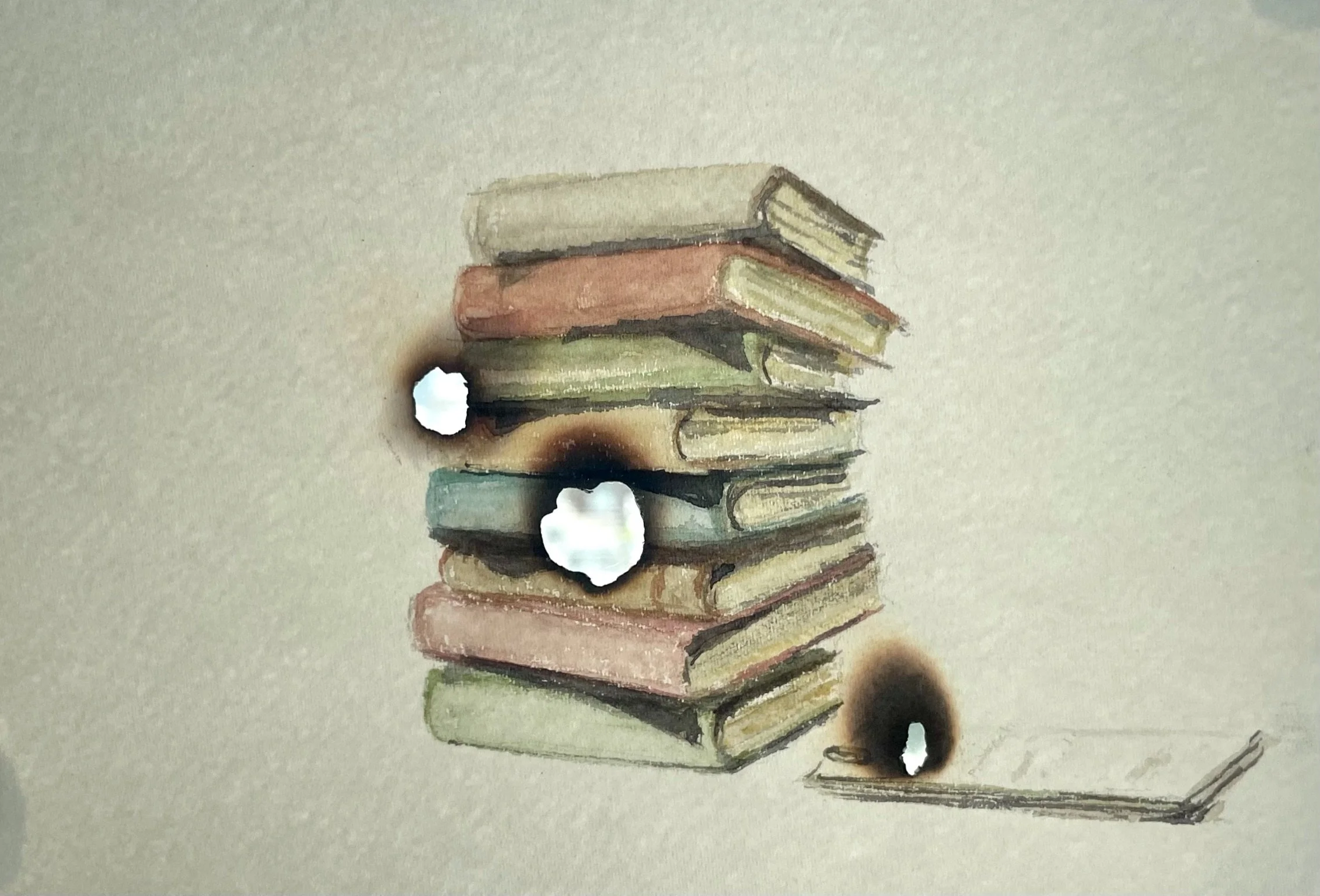
Image from Beaver Bentwood Box by Robin Roberts
Image from Burned Out Again by Carrie Jenkins, photography by Jonathan Ichikawa