
Bibliography
Bibliography main page; Theorizing UI; Doing UI;Types of UI; Calls to action; Barriers to UI; Proposed solutions; Funding; Critiquing DI; Who does UI; Where UI is or can be done; Being disciplined
Where Undisciplined Inquiry is or Can Be Done
These entries discuss institutional contexts in which undisciplined inquiry can be practiced.
Abel, J. 2013. The Place of Scraps. Talonbooks.
Publisher Abstract: The Place of Scraps revolves around Marius Barbeau, an early-twentieth-century ethnographer, who studied many of the First Nations cultures in the Pacific Northwest, including Jordan Abel's ancestral Nisga'a Nation. Barbeau, in keeping with the popular thinking of the time, believed First Nations cultures were about to disappear completely, and that it was up to him to preserve what was left of these dying cultures while he could. Unfortunately, his methods of preserving First Nations cultures included purchasing totem poles and potlatch items from struggling communities in order to sell them to museums. While Barbeau strove to protect First Nations cultures from vanishing, he ended up playing an active role in dismantling the very same cultures he tried to save. Drawing inspiration from Barbeau's canonical book Totem Poles, Jordan Abel explores the complicated relationship between First Nations cultures and ethnography. His poems simultaneously illuminate Barbeau's intentions and navigate the repercussions of the anthropologist's actions. Through the use of erasure techniques, Abel carves out new understandings of Barbeau's writing - each layer reveals a fresh perspective, each word takes on a different connotation, each letter plays a different role, and each punctuation mark rises to the surface in an unexpected way. As Abel writes his way ever deeper into Barbeau's words, he begins to understand that he is much more connected to Barbeau than he originally suspected.
Categories: Doing UI; Barriers to UI; Where UI is or can be done
Abel, J. 2015. Un/Inhabited. Project Space Press / Talonbooks.
Publisher Abstract: Award-winning Nisga’a poet Jordan Abel’s second collection of poetry, Un/inhabited, maps the terrain of the public domain to create a layered investigation of the interconnections between language and land. Abel constructed the book’s source text by compiling in their entirety ninety-one western novels found on the website Project Gutenberg, an online archive of works whose copyright has expired. Using his word processor’s Ctrl-F function, he searched the compilation for words that relate to the political and social aspects of land, territory, and ownership. Each search query represents a study in context (How was this word deployed? What surrounded it? What is left over once that word is removed?) accumulating toward a representation of the public domain as a discoverable and inhabitable body of land. Featuring a text by independent curator Kathleen Ritter – the first piece of scholarship on Abel’s work – Un/inhabited reminds us of the power of language as material and invites us to reflect on what is present in the empty space when we see nothing.
Categories: Doing UI; Critiquing DI; Where UI is or can be done
Abel, J. 2016. Injun. Talonbooks.
Publisher Abstract: Award-winning Nisga’a poet Jordan Abel’s third collection, Injun, is a long poem about racism and the representation of indigenous peoples. Composed of text found in western novels published between 1840 and 1950 – the heyday of pulp publishing and a period of unfettered colonialism in North America – Injun then uses erasure, pastiche, and a focused poetics to create a visually striking response to the western genre. After compiling the online text of 91 of these now public-domain novels into one gargantuan document, Abel used his word processor’s “Find” function to search for the word “injun.” The 509 results were used as a study in context: How was this word deployed? What surrounded it? What was left over once that word was removed? Abel then cut up the sentences into clusters of three to five words and rearranged them into the long poem that is Injun. The book contains the poem as well as peripheral material that will help the reader to replicate, intuitively, some of the conceptual processes that went into composing the poem. Though it has been phased out of use in our “post-racial” society, the word “injun” is peppered throughout pulp western novels. Injun retraces, defaces, and effaces the use of this word as a colonial and racial marker. While the subject matter of the source text is clearly problematic, the textual explorations in Injun help to destabilize the colonial image of the “Indian” in the source novels, the western genre as a whole, and the Western canon.
Categories: Doing UI; Critiquing DI; Where UI is or can be done
Abel, J. 2021. Nishga. McClelland and Stewart.
Publisher Abstract: As a Nisga'a writer, Jordan Abel often finds himself in a position where he is asked to explain his relationship to Nisga'a language, Nisga'a community, and Nisga'a cultural knowledge. However, as an intergenerational survivor of residential school--both of his grandparents attended the same residential school--his relationship to his own Indigenous identity is complicated to say the least. NISHGA explores those complications and is invested in understanding how the colonial violence originating at the Coqualeetza Indian Residential School impacted his grandparents' generation, then his father's generation, and ultimately his own. The project is rooted in a desire to illuminate the realities of intergenerational survivors of residential school, but sheds light on Indigenous experiences that may not seem to be immediately (or inherently) Indigenous. Drawing on autobiography and a series of interconnected documents (including pieces of memoir, transcriptions of talks, and photography), NISHGA is a book about confronting difficult truths and it is about how both Indigenous and non-Indigenous peoples engage with a history of colonial violence that is quite often rendered invisible.
Categories: Doing UI; Critiquing DI; Being disciplined; Where UI is or can be done
Archibald, J.-A. 2008. Indigenous Storywork. University of British Columbia Press.
Publisher Abstract: Indigenous oral narratives are an important source for, and component of, Coast Salish knowledge systems. Stories are not only to be recounted and passed down; they are also intended as tools for teaching. Jo-ann Archibald worked closely with Elders and storytellers, who shared both traditional and personal life-experience stories, in order to develop ways of bringing storytelling into educational contexts. Indigenous Storywork is the result of this research and it demonstrates how stories have the power to educate and heal the heart, mind, body, and spirit. It builds on the seven principles of respect, responsibility, reciprocity, reverence, holism, interrelatedness, and synergy that form a framework for understanding the characteristics of stories, appreciating the process of storytelling, establishing a receptive learning context, and engaging in holistic meaning-making.
Categories: Theorizing UI; Doing UI; Types of UI; Proposed solutions; Where UI is or can be done
Atleo, E. R. / Umeek. 2005. Tsawalk: A Nuu-chah-nulth Worldview. University of British Columbia Press.
Publisher Abstract: Western philosophy has long held scientific rationalism in a place of honour. Reason, that particularly exalted human quality, has become steadily distanced from the metaphysical aspects of existence, such as spirit, faith, and intuition. In Tsawalk, hereditary chief Umeek introduces us to an alternative indigenous worldview -- an ontology drawn from the Nuu-chah-nulth origin stories. Umeek develops a theory of "Tsawalk," meaning "one," that views the nature of existence as an integrated and orderly whole, and thereby recognizes the intrinsic relationship between the physical and spiritual. By retelling and analyzing the origin stories of Son of Raven and Son of Mucus, Umeek demonstrates how Tsawalk provides a viable theoretical alternative that both complements and expands the view of reality presented by Western science. Tsawalk, he argues, allows both Western and indigenous views to be combined in order to advance our understanding of the universe. In addition, he shows how various fundamental aspects of Nuu-chah-nulth society are based upon Tsawalk, and what implications it has today for both Native and non-Native peoples. A valuable contribution to Native studies, anthropology, and philosophy, Tsawalk offers a revitalizing and thoughtful complement to Western scientific worldviews.
Categories: Calls to action; Proposed solutions; Theorizing UI; Doing UI; Critiquing DI; Barriers to UI; Where UI is or can be done
Campbell, M. 2007 "We Need to Return to the Principles of Wahkotowin," in Eagle Feather News 10
Project Abstract: Campbell calls for Indigenous peoples to embody the principle of Wahkotowin, that is, kinship, relationship, and family with all of creation. Campbell laments the loss of this principle within Indigenous communities in Canada, and she points to some examples including the lack of safety and family support for Indigenous children, and the lack of “Indian status” for some Indigenous groups like the Lubicon Lake Cree Nation. Campbell emphasizes the importance of remembering Wahkotowin, especially for safeguarding Indigenous children.
Categories: Calls to action; Doing UI; Barriers to UI; Being disciplined; Where UI is or can be done
Diatta, M. 2023. “Undisciplining Who We Bring to the Academic Table: Practical Tactics to Accompany Critical Creative Inquiry,” in Parse 17.https://parsejournal.com/article/undisciplining-who-we-bring-to-the-academic-table
Project Abstract: In this article Diatta discusses undisciplined inquiry and creative practices in the context of citation practices, and asks, how can we repurpose creative practice towards the specific aim of undisciplining? Diatta pursues this question in order to challenge the traditional expectations that academic work arises from a literature review, is produced through a specific methodology, and contributes knowledge to a specific field or discipline. Diatta also gives an account of undisciplining, saying that “I use the term undisciplining to mean “a liberating act of temporarily suspending disciplinary regimes and practices in order to develop creative research (questions, ideas, and approaches)”.” Diatta disinguishes undisciplined inquiry from transdisciplinary inquiry, saying that what characterizes the former is “a fundamentally interior, critical, dark, disorderly place that makes it possible to imagine movements otherwise.”
Categories: Theorizing UI; Doing UI; Where UI is or can be done
Jenkins, C. 2017. What Love Is and What It Could Be. Basic Books.
Author Abstract: Based on the work of theMetaphysics of Love Project, this book unpicks the conceptual, ideological, and metaphysical tangles that get in the way of understanding what love is. What Love Is And What It Could Be explores different disciplinary perspectives on love, in search of the bigger picture. It presents a "dual-nature" theory: romantic love is simultaneously both a biological phenomenon and a social construct. The deep motivation behind this work is that we have a collective responsibility to figure out romantic love. It is a formidable and potentially dangerous force, its power underwritten by its twin footholds in our biological natures and in our most treasured social practices. Often we pretend that it is incomprehensible and out of control, but this is a way of abdicating our responsibility to understand love and fix it when it's broken. What Love Is And What It Could Be explains that romantic love is currently broken in multiple interlocking ways, but also that we can change this status quo. Once we understand what love is, we will be able to take control of what it could be.
Categories: Doing UI; Critiquing DI; Being Disciplined; Where UI is or can be done
Jenkins, C. 2022a. Sad Love: Romance and the Search for Meaning. Polity.
Author Abstract: What if your happy ever after … isn’t? This book is about sad love. Or, more accurately, it is about eudaimonic love, which has room for the full gamut of human experiences, both “positive” and “negative.” Eudaimonia, in the old sense (older than Aristotle!), was about benevolent spirits. In a contemporary setting, I frame eudaimonia in terms of how we are influenced by the people, environments, communities, and networks around us. As I see it, a proper understanding of eudaimonia demands that we take into account the deep and dramatic implications of our interconnectedness: we find meaning in collaboration and creation, and meaning is what makes life worth living for us. Eudaimonic love is collaborative, creative, and dynamic. It grows and changes. It orients us towards living a meaningful life, but away from the “pursuit of happiness,” including the romantic “happy ever after.” When we centre eudaimonia rather than romance, we can see why sad love is not necessarily a failure condition. Sadness – and other “negative” emotions – can be a legitimate part of a meaningful love story. Sad Love furthers the work of What Love Is in critiquing and dethroning culturally dominant romantic ideologies of love, especially the idea that love is defined by certain kinds of feelings. I have stopped asking how to be happy ever after in love. That question doesn’t interest me anymore.
Categories: Doing UI; Critiquing DI; Being Disciplined; Where UI is or can be done
Jenkins, C. 2023. Nonmonogamy and Happiness. Thornapple Press.
Author Abstract: The love story we’re all familiar with ends with “ … and they lived happily ever after.” But how often do we hear a nonmonogamous love story with that ending? In all kinds of contexts, nonmonogamous happiness is erased. From the ubiquitous “friend who tried it once and it didn’t end well” to Dan Savage’s long-term jokes about never being invited to a polyamorous third wedding anniversary, we are repeatedly assured that nonmonogamy leads to misery. In “real” love, we are taught to expect the opposite: to expect happiness. When we want to ask if someone’s relationship is going well, we ask if they are “happy with” their partner. We might even ask whether their partner makes them happy. But what does love have to do with happiness? Doesn’t love have space to accommodate the full range of emotional experience? Carrie Jenkins thinks it does, or at least it can. She draws connections between the expectation that love will make us happy and the undue focus on positive emotions to the exclusion of “negative” ones. She argues that love—monogamous or otherwise—might better aim at being eudaimonic than at being happy, and that we have a better chance of achieving this if we are able to make relationship choices free from the prejudices and distortions that lead to an unduly rosy view of monogamy and an unduly miserable picture of the alternatives.
Categories: Doing UI; Critiquing DI; Being Disciplined; Where UI is or can be done
Kimmerer, R. W. 2013. Braiding Sweetgrass. Indigenous Wisdom, Scientific Knowledge, and the Teachings of Plants. Milkweed Editions.
Publisher Abstract: An inspired weaving of indigenous knowledge, plant science, and personal narrative from a distinguished professor of science and a Native American whose previous book, Gathering Moss, was awarded the John Burroughs Medal for outstanding nature writing. As a botanist and professor of plant ecology, Robin Wall Kimmerer has spent a career learning how to ask questions of nature using the tools of science. As a Potawatomi woman, she learned from elders, family, and history that the Potawatomi, as well as a majority of other cultures indigenous to this land, consider plants and animals to be our oldest teachers. In Braiding Sweetgrass, Kimmerer brings these two lenses of knowing together to reveal what it means to see humans as "the younger brothers of creation." As she explores these themes she circles toward a central argument: the awakening of a wider ecological consciousness requires the acknowledgement and celebration of our reciprocal relationship with the world. Once we begin to listen for the languages of other beings, we can begin to understand the innumerable life-giving gifts the world provides us and learn to offer our thanks, our care, and our own gifts in return.
Categories: Proposed solutions; Doing UI; Types of UI; Who does UI; Where UI is or can be done; Barriers to UI
Liboiron, M. 2021. Pollution is Colonialism. Duke University Press.
Publisher Abstract: In Pollution Is Colonialism Max Liboiron presents a framework for understanding scientific research methods as practices that can align with or against colonialism. They point out that even when researchers are working toward benevolent goals, environmental science and activism are often premised on a colonial worldview and access to land. Focusing on plastic pollution, the book models an anticolonial scientific practice aligned with Indigenous, particularly Métis, concepts of land, ethics, and relations. Liboiron draws on their work in the Civic Laboratory for Environmental Action Research (CLEAR)—an anticolonial science laboratory in Newfoundland, Canada—to illuminate how pollution is not a symptom of capitalism but a violent enactment of colonial land relations that claim access to Indigenous land. Liboiron's creative, lively, and passionate text refuses theories of pollution that make Indigenous land available for settler and colonial goals. In this way, their methodology demonstrates that anticolonial science is not only possible but is currently being practiced in ways that enact more ethical modes of being in the world.
Categories: Calls to action; Theorizing UI; Doing UI; Types of UI; Where UI is or can be done
Lorde, A. 2020. The Selected Works of Audre Lorde: Edited and with an Introduction by Roxane Gay. W.W. Norton and Company.
Publisher Abstract: A definitive selection of prose and poetry from the self-described "black, lesbian, mother, warrior, poet," for a new generation of readers. Audre Lorde is an unforgettable voice in twentieth-century literature, one of the first to center the experiences of black, queer women. Her incisive essays and passionate poetry-alive with sensuality, vulnerability, and rage-remain indelible contributions to intersectional feminism, queer theory, and critical race studies. This essential reader showcases twelve landmark essays and more than sixty poems, selected and introduced by one of our most powerful contemporary voices on race and gender, Roxane Gay. The essays include "The Master's Tools Will Never Dismantle the Master's House," "I Am Your Sister," and excerpts from the National Book Award-winning A Burst of Light. The poems are drawn from Lorde's nine volumes, including National Book Award nominee The Land Where Other People Live. As Gay writes in her astute introduction, The Selected Works of Audre Lorde celebrates "an exemplar of public intellectualism who is as relevant in this century as she was in the last."
Categories: Calls to action; Doing UI; Types of UI; Critiquing DI; Being disciplined; Where UI is or can be done
Maracle, L. 2015. Memory Serves. NeWest Press.
Publisher Abstract: Memory Serves gathers together the oratories award-winning author Lee Maracle has delivered and performed over a twenty-year period. Revised for publication, the lectures hold the features and style of oratory intrinsic to the Salish people in general and the Sto: lo in particular. From her Coast Salish perspective and with great eloquence, Maracle shares her knowledge of Sto: lo history, memory, philosophy, law, spirituality, feminism and the colonial condition of her people. Powerful and inspiring, Memory Serves is an extremely timely book, not only because it is the first collection of oratories by one of the most important Indigenous authors in Canada, but also because it offers all Canadians, in Maracle's own words, "another way to be, to think, to know," a way that holds the promise of a "journey toward a common consciousness."
Categories: Calls to action; Theorizing UI; Doing UI; Proposed solutions; Critiquing DI; Being disciplined; Who does UI; Where UI is or can be done
Murthy, V. 2023. “Our Epidemic of Loneliness and Isolation: The U.S. Surgeon General’s Advisory on the Healing Effects of Social Connection and Community.”https://www.hhs.gov/sites/default/files/surgeon-general-social-connection-advisory.pdf
Author Abstract: This advisory calls attention to the importance of social connection for individual health as well as on community-wide metrics of health and well-being, and conversely the significant consequences when social connection is lacking. While social connection is often considered an individual challenge, this advisory explores and explains the cultural, community, and societal dynamics that drive connection and disconnection. It also offers recommendations for increasing and strengthening social connection through a whole-of-society approach. The advisory presents a framework for a national strategy with specific recommendations for the institutions that shape our day-to-day lives: governments, health care systems and insurers, public health departments, research institutions, philanthropy, schools, workplaces, community-based organizations, technology companies, and the media.
Categories: Calls to action; Proposed solutions; Where UI is or can be done
Osworth, A. E. 2021. We Are Watching Elizabeth Bright. Grand Central Publishing.
Publisher Abstract: In this thrilling story of survival and anger, a woman has her whole life turned upside down after speaking out against workplace hostility–and inadvertently becomes the leader of a cultural movement. Eliza Bright was living the dream as an elite video game coder at Fancy Dog Games when her private life suddenly became public. But is Eliza Bright a brilliant, self-taught coder bravely calling out the toxic masculinity and chauvinism that pervades her workplace and industry? Or, is Eliza Bright a woman who needs to be destroyed to protect "the sanctity of gaming culture"? It depends on who you ask… When Eliza reports an incident of workplace harassment that is quickly dismissed, she's forced to take her frustrations to a journalist who blasts her story across the Internet. She's fired and doxxed, and becomes a rallying figure for women across America. But she's also enraged the beast that is male gamers on 4Chan and Reddit, whose collective, unreliable voice narrates our story. Soon Eliza is in the cross-hairs of the gaming community, threatened and stalked as they monitor her every move online and across New York City. As the violent power of an angry male collective descends upon everyone in Eliza's life, it becomes increasingly difficult to know who to trust, even when she's eventually taken in and protected by an under-the-radar Collective known as the Sixsterhood. The violence moves from cyberspace to the real world, as a vicious male super-fan known only as The Inspectre is determined to exact his revenge on behalf of men everywhere. We watch alongside the Sixsterhood and subreddit incels as this dramatic cat-and-mouse game plays out to reach its violent and inevitable conclusion. This is an extraordinary, unputdownable novel that explores the dark recesses of the Internet and male rage, and the fragile line between the online world and real life. It's a thrilling story of female resilience and survival, packed with a powerful feminist message.
Categories: Being disciplined; Who does UI; Where UI is or can be done
Petroff, E. 1994. Body and Soul: Essays on Medieval Women and Mysticism. Oxford University Press.
Publisher Abstract: Opening a window onto a long-neglected world of women's experience, this text features eleven essays that examine the writings of medieval women mystics from England, France, Germany, Italy, and the Low Countries, providing close readings of a number of important texts from the viewpoint of different literary theories. Surveying various styles of hagiographical writing, the author offers ground-breaking scholarship on a broad range of topics such as how medieval holy women may have appeared to their contemporaries, medieval antifeminism, comparisons between earlier and later Christian mystical writing, the relationship between male confessors and female penitents in the Middle Ages, and the process by which these extraordinary women produced their work. For courses in religious, medieval, or women's studies, this unique text fills a conspicuous gap in an important and fascinating field of literature.
Categories: Doing UI; Barriers to UI; Who does UI; Where UI is or can be done
Whitehead, J. 2017. Full-Metal Indigiqueer. Talonbooks.
Abridged Publisher Abstract: This poetry collections focuses on a hybridized Indigiqueer Trickster character named Zoa who brings together the organic (the protozoan) and the technologic (the binaric) in order to re-beautify and re-member queer Indigeneity. This Trickster is a Two-Spirit / Indigiqueer invention that resurges in the apocalypse to haunt, atrophy, and to reclaim. Following oral tradition (à la Iktomi, Nanaboozho, Wovoka), Zoa infects, invades, and becomes a virus to canonical and popular works in order to re-centre Two-Spirit livelihoods. Zoa world-builds a fourth-dimension, lives in the cyber space, and survives in NDN-time – they have learned to sing the skin back onto their bodies and remain #woke at the end of the world. “Do not read me as a vanished ndn,” they ask, “read me as a ghastly one.” This project follows in the tradition of authors who, Whitehead believes, utilize deconstruction as a means of decolonization. This is a sex-positive project that tirelessly works to create coalition between those who have, as Donna Haraway once noted, “been injured, profoundly.” Zoa stands in solidarity with all qpoc folk who exist as ghosts with intergenerational and colonial phantom pains.
Categories: Theorizing UI; Doing UI; Critiquing DI; Barriers to UI; Who Does UI’ Being Disciplined; Where UI is or can be done
Whitehead, J. 2022. Making Love with the Land. Knopf Canada.
Publisher Abstract: Making Love with the Land is a startling, challenging, uncompromising look at what it means to live as an Indigenous person “in the rupture” between identities. In these ten unique, heart-piercing non-fiction pieces, award-winning writer Joshua Whitehead illuminates the complex moment we’re living through now, in which Indigenous and non-Indigenous peoples are navigating new and old ideas about “the land.” He asks: What is our relationship and responsibility towards it? And how has the land shaped ideas, histories, words, our very bodies? Intellectually thrilling and emotionally captivating, this book is a love song for the world—and for the library of stories to be found where body meets land, waiting to be unearthed and summoned into word.
Categories: Who Does UI; Being Disciplined; Doing UI; Where UI is or can be done
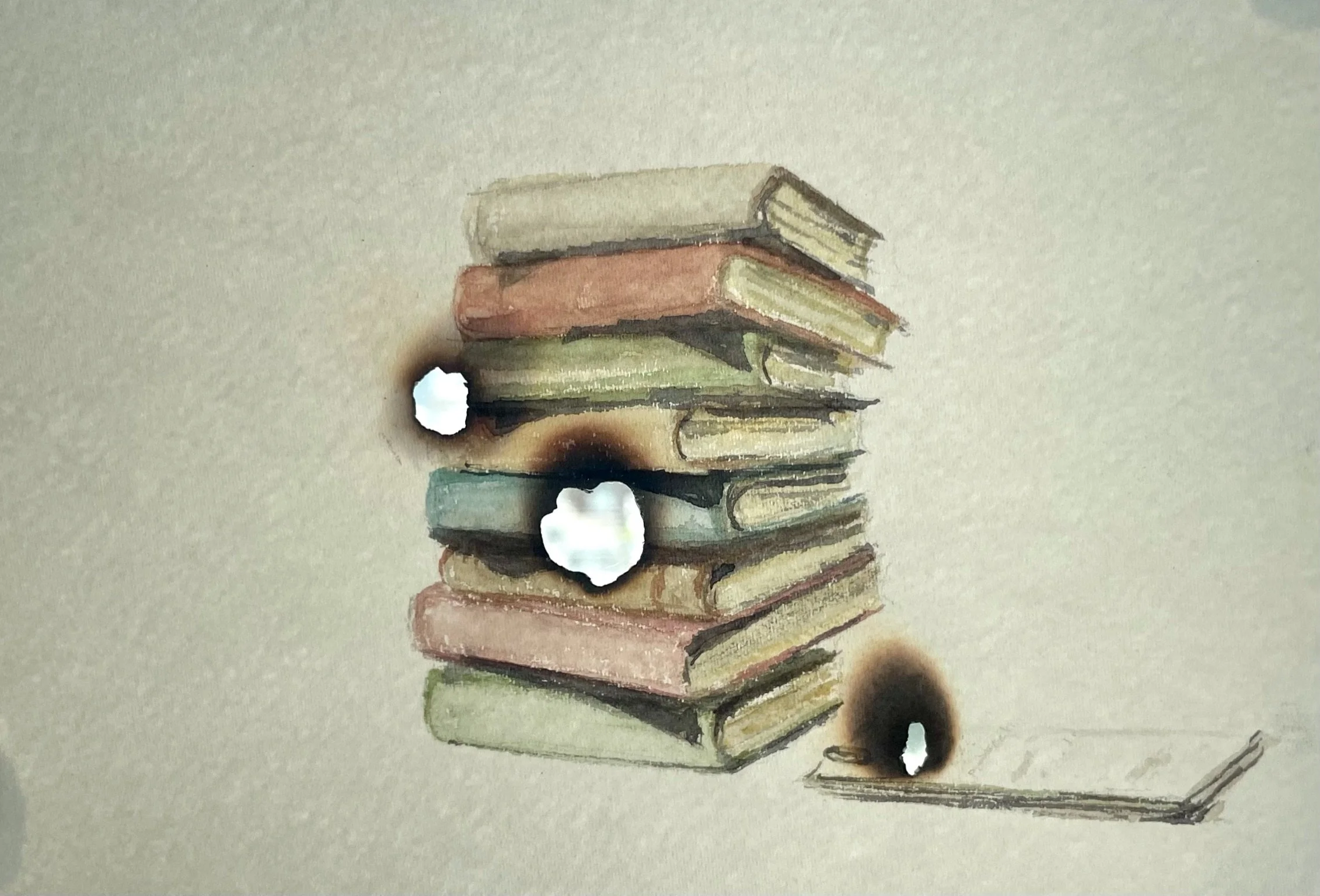
Image from Beaver Bentwood Box by Robin Roberts
Image from Burned Out Again by Carrie Jenkins, photography by Jonathan Ichikawa