
Bibliography
Bibliography main page; Theorizing UI; Doing UI;Types of UI; Calls to action; Barriers to UI; Proposed solutions; Funding; Critiquing DI; Who does UI; Where UI is or can be done; Being disciplined
Who Does Undisciplined Inquiry
These entries consider which groups of people engage in undisciplined inquiry, and how their social positions influence their practice of undisciplined inquiry.
de Beauvoir, S. 1949. The Second Sex. Trans. C. Borde and S. Mallovany-Chevallier. Edn. of 2011. Vintage.
Project Abstract: A foundational text of feminist theory in which de Beauvoir explains how women are socially constructed as Others within patriarchal society. In this work, and by drawing from existentialism, phenomenology, sociology, and history, de Beauvoir develops and utilizes a method of feminist inquiry that explored women’s oppression and unfreedom under patriarchy.
Categories: Doing UI; Critiquing DI; Who does UI; Being disciplined
Cordova, V. 2004. “Ethics: From an Artist’s Point of View,” in A. Waters (ed.) American Indian Thought: Philosophical Essays, pp. 251-5.
Project Abstract: In this entry Cordova discusses two very different conceptions of an artist. The “Western” conception sees artists as a disruptive force to their society, an individual who is alienated from their society and whose role is to unveil the chaos that is masked by their society’s norms. The “Native American” conception sees artists as akin to healers or scientists. The artist seeks knowledge, and is responsible to their community for the works they create, and Cordova describes how the artist is socialized into this responsibility. Cordova highlights how these conceptions are intertwined with different metaphysical pictures of reality, and that in the Native American worldview reality is fundamentally ordered, though always changing; given this, there can be no distinction between ethics and aesthetics.
Categories: Theorizing UI; Critiquing DI; Types of UI; Who does UI
Khan, S. 2022. “Becoming Undisciplined: Disciplinary and Disciplining Norms” in ASAP review.https://asapjournal.com/node/becoming-undisciplined-disciplinary-and-disciplining-norms-sanaa-khan/
Project Abstract: Using excerpts from her personal journal, correspondence with friends, and correspondence with university administrators, Khan explores her experience of being disciplined into following the norms of (colonial) academia and the expectation that she submit to those norms. Khan considers how the process of becoming disciplined is detrimental to her health, and how becoming undisciplined is necessary for her survival.
Categories: Doing UI; Critiquing DI; Barriers to UI; Who does UI; Being disciplined
Keynes, J. M. 1942. “Newton, the Man.” Speech prepared for a tercentenary celebration of Isaac Newton’s birth, at the Royal Society of London.https://mathshistory.st-andrews.ac.uk/Extras/Keynes_Newton
Project Abstract: In this lecture, written for an event marking the tricentenary of Sir Isaac Newton’s death, Keynes challenges the once-dominant conventional characterization of Newton as “the first and greatest of the modern age of science.” Keynes instead describes Newton as not “the first of the age of reason” but as “the last of the magicians.” Keynes’s lecture explores Newton’s inquiries into alchemy and mysticism, and says that Newton only transformed into the “Monarch of the Age of Reason” later in life, through the efforts of Newton’s friends, and following his own nervous breakdown.
Categories: Types of UI; Who does UI; Being disciplined
Kimmerer, R. W. 2013. Braiding Sweetgrass. Indigenous Wisdom, Scientific Knowledge, and the Teachings of Plants. Milkweed Editions.
Publisher Abstract: An inspired weaving of indigenous knowledge, plant science, and personal narrative from a distinguished professor of science and a Native American whose previous book, Gathering Moss, was awarded the John Burroughs Medal for outstanding nature writing. As a botanist and professor of plant ecology, Robin Wall Kimmerer has spent a career learning how to ask questions of nature using the tools of science. As a Potawatomi woman, she learned from elders, family, and history that the Potawatomi, as well as a majority of other cultures indigenous to this land, consider plants and animals to be our oldest teachers. In Braiding Sweetgrass, Kimmerer brings these two lenses of knowing together to reveal what it means to see humans as "the younger brothers of creation." As she explores these themes she circles toward a central argument: the awakening of a wider ecological consciousness requires the acknowledgement and celebration of our reciprocal relationship with the world. Once we begin to listen for the languages of other beings, we can begin to understand the innumerable life-giving gifts the world provides us and learn to offer our thanks, our care, and our own gifts in return.
Categories: Proposed solutions; Doing UI; Types of UI; Who does UI; Where UI is or can be done; Barriers to UI
Maracle, L. 2015. Memory Serves. NeWest Press.
Publisher Abstract: Memory Serves gathers together the oratories award-winning author Lee Maracle has delivered and performed over a twenty-year period. Revised for publication, the lectures hold the features and style of oratory intrinsic to the Salish people in general and the Sto: lo in particular. From her Coast Salish perspective and with great eloquence, Maracle shares her knowledge of Sto: lo history, memory, philosophy, law, spirituality, feminism and the colonial condition of her people. Powerful and inspiring, Memory Serves is an extremely timely book, not only because it is the first collection of oratories by one of the most important Indigenous authors in Canada, but also because it offers all Canadians, in Maracle's own words, "another way to be, to think, to know," a way that holds the promise of a "journey toward a common consciousness."
Categories: Calls to action; Theorizing UI; Doing UI; Proposed solutions; Critiquing DI; Being disciplined; Who does UI; Where UI is or can be done
Osworth, A. E. 2021. We Are Watching Elizabeth Bright. Grand Central Publishing.
Publisher Abstract: In this thrilling story of survival and anger, a woman has her whole life turned upside down after speaking out against workplace hostility–and inadvertently becomes the leader of a cultural movement. Eliza Bright was living the dream as an elite video game coder at Fancy Dog Games when her private life suddenly became public. But is Eliza Bright a brilliant, self-taught coder bravely calling out the toxic masculinity and chauvinism that pervades her workplace and industry? Or, is Eliza Bright a woman who needs to be destroyed to protect "the sanctity of gaming culture"? It depends on who you ask… When Eliza reports an incident of workplace harassment that is quickly dismissed, she's forced to take her frustrations to a journalist who blasts her story across the Internet. She's fired and doxxed, and becomes a rallying figure for women across America. But she's also enraged the beast that is male gamers on 4Chan and Reddit, whose collective, unreliable voice narrates our story. Soon Eliza is in the cross-hairs of the gaming community, threatened and stalked as they monitor her every move online and across New York City. As the violent power of an angry male collective descends upon everyone in Eliza's life, it becomes increasingly difficult to know who to trust, even when she's eventually taken in and protected by an under-the-radar Collective known as the Sixsterhood. The violence moves from cyberspace to the real world, as a vicious male super-fan known only as The Inspectre is determined to exact his revenge on behalf of men everywhere. We watch alongside the Sixsterhood and subreddit incels as this dramatic cat-and-mouse game plays out to reach its violent and inevitable conclusion. This is an extraordinary, unputdownable novel that explores the dark recesses of the Internet and male rage, and the fragile line between the online world and real life. It's a thrilling story of female resilience and survival, packed with a powerful feminist message.
Categories: Being disciplined; Who does UI; Where UI is or can be done
Osworth, A. E. 2025. Awakened. Grand Central Publishing.
Publisher Abstract: A coven of trans witches battle an evil AI in the magical coming-of-middle-age romp about love, loss, drag shows, and late capitalism. On a morning much like any other, 30-something queer Brooklynite Wilder makes a miraculous discovery: suddenly, as if by magic, they can understand every language in the world. Dazed and disconnected, Wilder is found and taken in by a small coven of trans witches who have all become Awakened with mystical powers of their own. Quibble, a handsome portal traveler, Artemis, the group’s caretaker and seer, and Mary Margaret, a smart-ass teen with telekinetic powers all work to make the cagey and suspicious Wilder feel at home, both within their group and with the knowledge that magic is, in fact, real. Just as Wilder is finding their footing, a malicious AI threatens to dismantle the delicate balance of the coven and the world as they know it. The group scrambles to stay united as they question whether any consciousness—be it artificial, material, or magical—is too dangerous to exist. Awakened is a hilarious, thought-provoking reflection on the ways that we are responsible for creating our own realities, a story of finding community, and a meditation on what it means to have a body.
Categories: Doing UI; Who does UI; Being disciplined
Petroff, E. 1994. Body and Soul: Essays on Medieval Women and Mysticism. Oxford University Press.
Publisher Abstract: Opening a window onto a long-neglected world of women's experience, this text features eleven essays that examine the writings of medieval women mystics from England, France, Germany, Italy, and the Low Countries, providing close readings of a number of important texts from the viewpoint of different literary theories. Surveying various styles of hagiographical writing, the author offers ground-breaking scholarship on a broad range of topics such as how medieval holy women may have appeared to their contemporaries, medieval antifeminism, comparisons between earlier and later Christian mystical writing, the relationship between male confessors and female penitents in the Middle Ages, and the process by which these extraordinary women produced their work. For courses in religious, medieval, or women's studies, this unique text fills a conspicuous gap in an important and fascinating field of literature.
Categories: Doing UI; Barriers to UI; Who does UI; Where UI is or can be done
Schilt, K. “The ‘Not Sociology’ Problem,” in D. Compton, T. Meadow and K. Schilt (ed.s)Other, Please Specify: Queer Methods in Sociology, University of California Press, pp. 37-50.
Project Abstract: in this article Schilt explores how the disciplinary boundary of sociology is gatekept with three strategies that dismiss disruptive research as “not sociology.” Resistance attempts to erect boundaries against an emerging area of inquiry. Reduction dismisses emerging scholarship as unimportant, irrelevant, or as “too niche” to matter. Ridicule devalues inquiry by depicting it as absurd, or by questioning its scholarly credentials. Schilt provides a case study of each of these strategies. Schilt also discusses who can engage in UI, and identifies different challenges faced by tenured and non-tenured scholars.
Categories: Critiquing DI; Barriers to UI; Who does UI
Ward, J. 2018. “The Methods Gatekeepers and the Exiled Queers,” in D. Compton, T. Meadow and K. Schilt (ed.s)Other, Please Specify: Queer Methods in Sociology, University of California Press, pp. 51-66.
Project Abstract: in this book chapter, Ward explores the “tense but dynamic relationship between sociological methods and queer methods” via an ethnography of their own career trajectory. Ward takes the term “mansplaining” and expands it to capture another form of epistemic arrogance, methodsplaining. Ward explains how queer, trans, and sociologists from other underrepresented groups are often met with skepticism that their methodologies are not “proper sociology.” Ward then details how this supposedly neutral and objective critique is inseparable from conservative political agendas. The result is queer scholars are exiled from sociology.
Categories: Calls to action; Theorizing UI; Critiquing DI; Barriers to UI; Types of UI; Who does UI; Being disciplined
Whitehead, J. 2017. Full-Metal Indigiqueer. Talonbooks.
Abridged Publisher Abstract: This poetry collections focuses on a hybridized Indigiqueer Trickster character named Zoa who brings together the organic (the protozoan) and the technologic (the binaric) in order to re-beautify and re-member queer Indigeneity. This Trickster is a Two-Spirit / Indigiqueer invention that resurges in the apocalypse to haunt, atrophy, and to reclaim. Following oral tradition (à la Iktomi, Nanaboozho, Wovoka), Zoa infects, invades, and becomes a virus to canonical and popular works in order to re-centre Two-Spirit livelihoods. Zoa world-builds a fourth-dimension, lives in the cyber space, and survives in NDN-time – they have learned to sing the skin back onto their bodies and remain #woke at the end of the world. “Do not read me as a vanished ndn,” they ask, “read me as a ghastly one.” This project follows in the tradition of authors who, Whitehead believes, utilize deconstruction as a means of decolonization. This is a sex-positive project that tirelessly works to create coalition between those who have, as Donna Haraway once noted, “been injured, profoundly.” Zoa stands in solidarity with all qpoc folk who exist as ghosts with intergenerational and colonial phantom pains.
Categories: Theorizing UI; Doing UI; Critiquing DI; Barriers to UI; Who Does UI; Being Disciplined; Where UI is or can be done
Whitehead, J. 2022. Making Love with the Land. Knopf Canada.
Publisher Abstract: Making Love with the Land is a startling, challenging, uncompromising look at what it means to live as an Indigenous person “in the rupture” between identities. In these ten unique, heart-piercing non-fiction pieces, award-winning writer Joshua Whitehead illuminates the complex moment we’re living through now, in which Indigenous and non-Indigenous peoples are navigating new and old ideas about “the land.” He asks: What is our relationship and responsibility towards it? And how has the land shaped ideas, histories, words, our very bodies? Intellectually thrilling and emotionally captivating, this book is a love song for the world—and for the library of stories to be found where body meets land, waiting to be unearthed and summoned into word.
Categories: Who Does UI; Being Disciplined; Doing UI; Where UI is or can be done
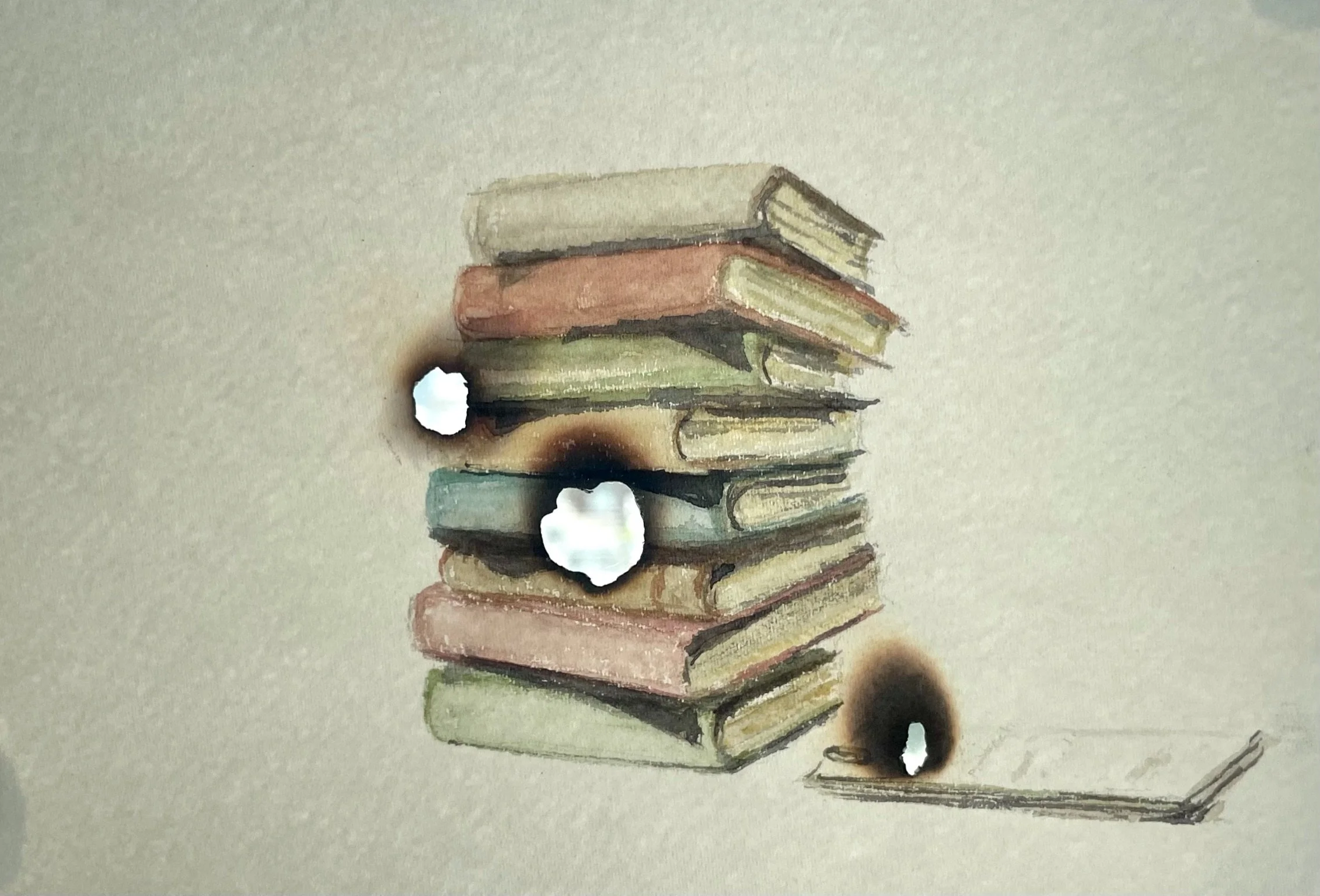
Image from Beaver Bentwood Box by Robin Roberts
Image from Burned Out Again by Carrie Jenkins, photography by Jonathan Ichikawa