
Bibliography
Bibliography main page; Theorizing UI; Doing UI;Types of UI; Calls to action; Barriers to UI; Proposed solutions; Funding; Critiquing DI; Who does UI; Where UI is or can be done; Being disciplined
Types of Undisciplined Inquiry
These entries explore practices that constitute doing undisciplined inquiry (examples include “two-eyed seeing”, and “land-based pedagogies”).
Abolmaesumi, P., Black, J., Boyd, Jenkins, C., L. Kong, H., Ramana, M., Reynolds, S., Stack, M., Teves, S., and Troeung, Y-D. 2021. Chromatic: Ten Meditations on Crisis in Art and Letters. Peter Wall Institute for Advanced Studies, UBC.
Publisher Abstract: A collection of essays and illustrations as diverse as the subject of crisis itself. Imagined and brought to life by leading UBC scholars in collaboration with local artists, Chromatic asks what it means to be in crisis and grapples with the personal and societal impacts of crisis during a time of unprecedented global upheaval. Each contributor to this diverse collection takes a profoundly different approach yet fascinating and unexpected connections emerge. The result is a book that juxtaposes gorgeous, colourful artwork with writing that will surprise and challenge you, outrage and enlighten you. From a precise discussion of a nuclear crisis in Japan, to a satirical listicle about corporate academia, to an ICU doctor's poetic response to COVID-19, each contributor to this diverse collection takes a profoundly different approach to writing about crisis, yet fascinating and unexpected connections emerge.
Categories: Doing UI; Calls to action; Types of UI; Being disciplined
Archibald, J.-A. 2008. Indigenous Storywork. University of British Columbia Press.
Publisher Abstract: Indigenous oral narratives are an important source for, and component of, Coast Salish knowledge systems. Stories are not only to be recounted and passed down; they are also intended as tools for teaching. Jo-ann Archibald worked closely with Elders and storytellers, who shared both traditional and personal life-experience stories, in order to develop ways of bringing storytelling into educational contexts. Indigenous Storywork is the result of this research and it demonstrates how stories have the power to educate and heal the heart, mind, body, and spirit. It builds on the seven principles of respect, responsibility, reciprocity, reverence, holism, interrelatedness, and synergy that form a framework for understanding the characteristics of stories, appreciating the process of storytelling, establishing a receptive learning context, and engaging in holistic meaning-making.
Categories: Theorizing UI; Doing UI; Types of UI; Proposed solutions; Where UI is or can be done
Burkhart, B. 2019. Indigenizing Philosophy Through the Land: a Trickster Methodology for Decolonizing Environmental Ethics and Indigenous Futures. Michigan State University Press.
Author Abstract: Land is key to the operations of coloniality, but the power of the land is also the key anticolonial force that grounds Indigenous liberation. This work is an attempt to articulate the nature of land as a material, conceptual, and ontological foundation for Indigenous ways of knowing, being, and valuing. As a foundation of valuing, land forms the framework for a conceptualization of Indigenous environmental ethics as an anticolonial force for sovereign Indigenous futures. This text is an important contribution in the efforts to Indigenize Western philosophy, particularly in the context of settler colonialism in the United States. It breaks significant ground in articulating Indigenous ways of knowing and valuing to Western philosophy—not as artifact that Western philosophy can incorporate into its canon, but rather as a force of anticolonial Indigenous liberation. Ultimately, Indigenizing Philosophy through the Land shines light on a possible road for epistemically, ontologically, and morally sovereign Indigenous futures.
Categories: Calls to action; Proposed solutions; Theorizing UI; Doing UI; Critiquing DI, Types of UI
Cordova, V. 2004. “Ethics: From an Artist’s Point of View,” in A. Waters (ed.) American Indian Thought: Philosophical Essays, pp. 251-5.
Project Abstract: In this entry Cordova discusses two very different conceptions of an artist. The “Western” conception sees artists as a disruptive force to their society, an individual who is alienated from their society and whose role is to unveil the chaos that is masked by their society’s norms. The “Native American” conception sees artists as akin to healers or scientists. The artist seeks knowledge, and is responsible to their community for the works they create, and Cordova describes how the artist is socialized into this responsibility. Cordova highlights how these conceptions are intertwined with different metaphysical pictures of reality, and that in the Native American worldview reality is fundamentally ordered, though always changing; given this, there can be no distinction between ethics and aesthetics.
Categories: Theorizing UI; Critiquing DI; Types of UI; Who does UI
Descartes, R. 1641. Meditations on First Philosophy in Which the Existence of God and the Distinction of the Soul from the Body are Demonstrated. Trans. D. Cress. 3rd edn. Hackett.
Project Abstract: Descartes’s Meditations showcases Descartes breaking with the then-standard form of scholarly treatise. A typical treatise would consist in presenting the various sides to a disputation, and would cite accepted definitions and established authorities. Descartes does none of this, and is critical of this approach. He insists that a meditative approach is required if we are to avoid reproducing our biases and assumptions.
Categories: Doing UI; Critiquing DI; Types of UI
Frantz, J. and Grosse, S. (Producers), Gwaai Edenshaw and Helen Haig-Brown (Directors). 2018. SG̲aawaay Ḵ’uuna. Niijang Xyaalas Productions.
Abridged Abstract (from The Bows Gallery): Set in the Haida Gwaii region in the 19th century, the film adapts a classic Haida folk tale of a man left for dead in the forest who becomes the Gaagiid/Gaagiixiid (Wildman). After an accident where he is separated from his family, Adiits’ii wanders through the forest becoming driven mad by both natural and supernatural forces. As his loved ones, including best friend Kwa, set out to capture and cure him, Adiits’ii grows increasingly feral. More broadly, the film aims to tell a Haida story, in and about ancestral Haida lands. As Edenshaw notes: “something that people don’t know is that Gaagiixid is a real thing. It’s something that happens to people; you can, if you are exposed to the elements, easily and quickly slip into that state of being. I think that people are familiar with Gaagiixid as a monster story or something like that, but really, it’s about what’s going on inside of the person who is the monster—not so much anybody else being threatened by them.”
Categories: Doing UI; Types of UI
Jenkins, C. 2022b. “Love as a Gift Economy,” in New Philosopher 35.
Project Abstract: In this essay Jenkins uses Robin Wall Kimmerer’s framework of the Gift Economy to reconceptualize practices of romantic love. Jenkins discusses the capitalist commodification of women’s care, love, attention, and reproductive labour as scarce resources that must be hoarded and controlled, and she explores what it might mean if love were instead construed as a gift, drawing a comparison with a statement made by a rainforest hunter-gatherer, that “I store my [excess] meat in the belly of my brother.”
Categories: Theorizing UI; Barriers to UI; Types of UI; Being Disciplined
Kimmerer, R. W. 2013. Braiding Sweetgrass. Indigenous Wisdom, Scientific Knowledge, and the Teachings of Plants. Milkweed Editions.
Publisher Abstract: An inspired weaving of indigenous knowledge, plant science, and personal narrative from a distinguished professor of science and a Native American whose previous book, Gathering Moss, was awarded the John Burroughs Medal for outstanding nature writing. As a botanist and professor of plant ecology, Robin Wall Kimmerer has spent a career learning how to ask questions of nature using the tools of science. As a Potawatomi woman, she learned from elders, family, and history that the Potawatomi, as well as a majority of other cultures indigenous to this land, consider plants and animals to be our oldest teachers. In Braiding Sweetgrass, Kimmerer brings these two lenses of knowing together to reveal what it means to see humans as "the younger brothers of creation." As she explores these themes she circles toward a central argument: the awakening of a wider ecological consciousness requires the acknowledgement and celebration of our reciprocal relationship with the world. Once we begin to listen for the languages of other beings, we can begin to understand the innumerable life-giving gifts the world provides us and learn to offer our thanks, our care, and our own gifts in return.
Categories: Proposed solutions; Doing UI; Types of UI; Who does UI; Where UI is or can be done; Barriers to UI
Kimmerer, R. W. 2022. “The Serviceberry: An Economy of Abundance,” in Emergence Magazine.
Author Abstract: As Robin Wall Kimmerer harvests serviceberries alongside the birds, she considers the ethic of reciprocity that lies at the heart of the gift economy. How, she asks, can we learn from Indigenous wisdom and ecological systems to reimagine currencies of exchange?
Categories: Theorizing UI; Doing UI; Barriers to UI; Types of UI
Kirk, G., J., Raven, J., and Schofield, M. 1983. The Presocratic Philosophers, 2nd edn. Cambridge University Press.
Publisher Abstract: Beginning with a long and extensively rewritten introduction surveying the predecessors of the Presocratics, this book traces the intellectual revolution initiated by Thales in the sixth century BC to its culmination in the metaphysics of Parmenides and the complex physical theories of Anaxagoras and the Atomists in the fifth century it is based on a selection of some six hundred texts, in Greek and a close English translation which in this edition is given more prominence. These provide the basis for a detailed critical study of the principal individual thinkers of the time. Besides serving as an essential text for undergraduate and graduate courses in Greek philosophy and in the history of science, this book will appeal to a wide range of readers with interests in philosophy, theology, the history of ideas and of the ancient world, and indeed to anyone who wants an authoritative account of the Presocratics.
Categories: Theorizing UI; Types of UI
Liboiron, M. 2021. Pollution is Colonialism. Duke University Press.
Publisher Abstract: In Pollution Is Colonialism Max Liboiron presents a framework for understanding scientific research methods as practices that can align with or against colonialism. They point out that even when researchers are working toward benevolent goals, environmental science and activism are often premised on a colonial worldview and access to land. Focusing on plastic pollution, the book models an anticolonial scientific practice aligned with Indigenous, particularly Métis, concepts of land, ethics, and relations. Liboiron draws on their work in the Civic Laboratory for Environmental Action Research (CLEAR)—an anticolonial science laboratory in Newfoundland, Canada—to illuminate how pollution is not a symptom of capitalism but a violent enactment of colonial land relations that claim access to Indigenous land. Liboiron's creative, lively, and passionate text refuses theories of pollution that make Indigenous land available for settler and colonial goals. In this way, their methodology demonstrates that anticolonial science is not only possible but is currently being practiced in ways that enact more ethical modes of being in the world.
Categories: Calls to action; Theorizing UI; Doing UI; Types of UI; Where UI is or can be done
Lorde, A. 2020. The Selected Works of Audre Lorde: Edited and with an Introduction by Roxane Gay. W.W. Norton and Company.
Publisher Abstract: A definitive selection of prose and poetry from the self-described "black, lesbian, mother, warrior, poet," for a new generation of readers. Audre Lorde is an unforgettable voice in twentieth-century literature, one of the first to center the experiences of black, queer women. Her incisive essays and passionate poetry-alive with sensuality, vulnerability, and rage-remain indelible contributions to intersectional feminism, queer theory, and critical race studies. This essential reader showcases twelve landmark essays and more than sixty poems, selected and introduced by one of our most powerful contemporary voices on race and gender, Roxane Gay. The essays include "The Master's Tools Will Never Dismantle the Master's House," "I Am Your Sister," and excerpts from the National Book Award-winning A Burst of Light. The poems are drawn from Lorde's nine volumes, including National Book Award nominee The Land Where Other People Live. As Gay writes in her astute introduction, The Selected Works of Audre Lorde celebrates "an exemplar of public intellectualism who is as relevant in this century as she was in the last."
Categories: Calls to action; Doing UI; Types of UI; Critiquing DI; Being disciplined; Where UI is or can be done
Loveless, N. 2019. How to Make Art at the End of the World: A Manifesto for Research-Creation. Duke University Press.
Publisher Abstract: In recent years, the rise of research-creation—a scholarly activity that considers art practices as research methods in their own right—has emerged from the organic convergences of the arts and interdisciplinary humanities, and it has been fostered by universities wishing to enhance their public profiles. In How to Make Art at the End of the World Natalie Loveless draws on diverse perspectives—from feminist science studies to psychoanalytic theory, as well as her own experience advising undergraduate and graduate students—to argue for research-creation as both a means to produce innovative scholarship and a way to transform pedagogy and research within the contemporary neoliberal university. Championing experimental, artistically driven methods of teaching, researching, and publication, research-creation works to render daily life in the academy more pedagogically, politically, and affectively sustainable, as well as more responsive to issues of social and ecological justice.
Categories: Calls to action; Theorizing UI; Proposed solutions; Doing UI; Critiquing DI; Being disciplined; Types of UI
Spinoza, B. 1677. Ethics: Proved in Geometrical Order. Trans. M. Silverthorne and M. Kisner. Edn. of 2018. Cambridge University Press.
Project Abstract: Spinoza’s Ethics has two central aims. The first is to explain the fundamental nature of reality. The second is to provide an ethical theory that explains virtue, perfection, freedom and our highest good. The metaphysical project provides us with knowledge of nature and the mind’s union with nature, while the ethical project shows us how this knowledge leads us to ethical ends, including attaining the highest good, the source of our highest happiness. Spinoza utilizes a geometrical method. Every conclusion is spelled out in a numbered proposition. In order to ensure the certainty of the conclusions, each proposition is accompanied by a proof, which deduces the proposition from the preceding propositions, as well as from a collection of axioms or necessary truths, and definitions of the fundamental terms. Whereas Euclid applied this geometric method to abstract, ideal figures, such as perfect circles, triangles and planes, Spinoza applied it to metaphysics, the study of the reality and natures of things, including things that exist in nature: minds, bodies, human beings. Spinoza’s method supposes that reality possesses a rational order, such that we can understand the natures of things by analyzing the logical relations among our concepts. Notably, Spinoza uses “God” and “nature” for the same entity, which is all that exists. This is strikingly similar to E. Richard Atleo’s description of the Nuu-chah-nulth worldview of “tsawalk”, that everything is one. This similarity highlights that Western and Indigenous knowledge practices should not be seen as a strict oppositional binary.
Categories: Doing UI; Types of UI
Ward, J. 2018. “The Methods Gatekeepers and the Exiled Queers,” in D. Compton, T. Meadow and K. Schilt (ed.s)Other, Please Specify: Queer Methods in Sociology, University of California Press, pp. 51-66.
Project Abstract: in this book chapter, Ward explores the “tense but dynamic relationship between sociological methods and queer methods” via an ethnography of their own career trajectory. Ward takes the term “mansplaining” and expands it to capture another form of epistemic arrogance, methodsplaining. Ward explains how queer, trans, and sociologists from other underrepresented groups are often met with skepticism that their methodologies are not “proper sociology.” Ward then details how this supposedly neutral and objective critique is inseparable from conservative political agendas. The result is queer scholars are exiled from sociology.
Categories: Calls to action; Theorizing UI; Critiquing DI; Barriers to UI; Types of UI; Who does UI; Being disciplined
Yahgulanaas, M. N. 2009. Red: A Haida Manga. Douglas and McIntyre.
Publisher Abstract (abridged): Referencing a classic Haida oral narrative, this stunning full-colour graphic novel documents the tragic story of a leader so blinded by revenge that he leads his community to the brink of war and destruction. Consisting of 108 pages of hand-painted illustrations, Red is a groundbreaking mix of Haida imagery and Japanese manga. Red is the prideful leader of a small village in the islands off the northwest coast of British Columbia. His sister was abducted years ago by a band of raiders. When news comes that she has been spotted in a nearby village, Red sets out to rescue his sister and exact revenge on her captors. Tragic and timeless, it is reminiscent of such classic stories as Oedipus Rex and Macbeth. Red is an action-packed and dazzling graphic novel that is also a cautionary tale about the devastating effects of rage and retribution.
Categories: Doing UI; Types of UI
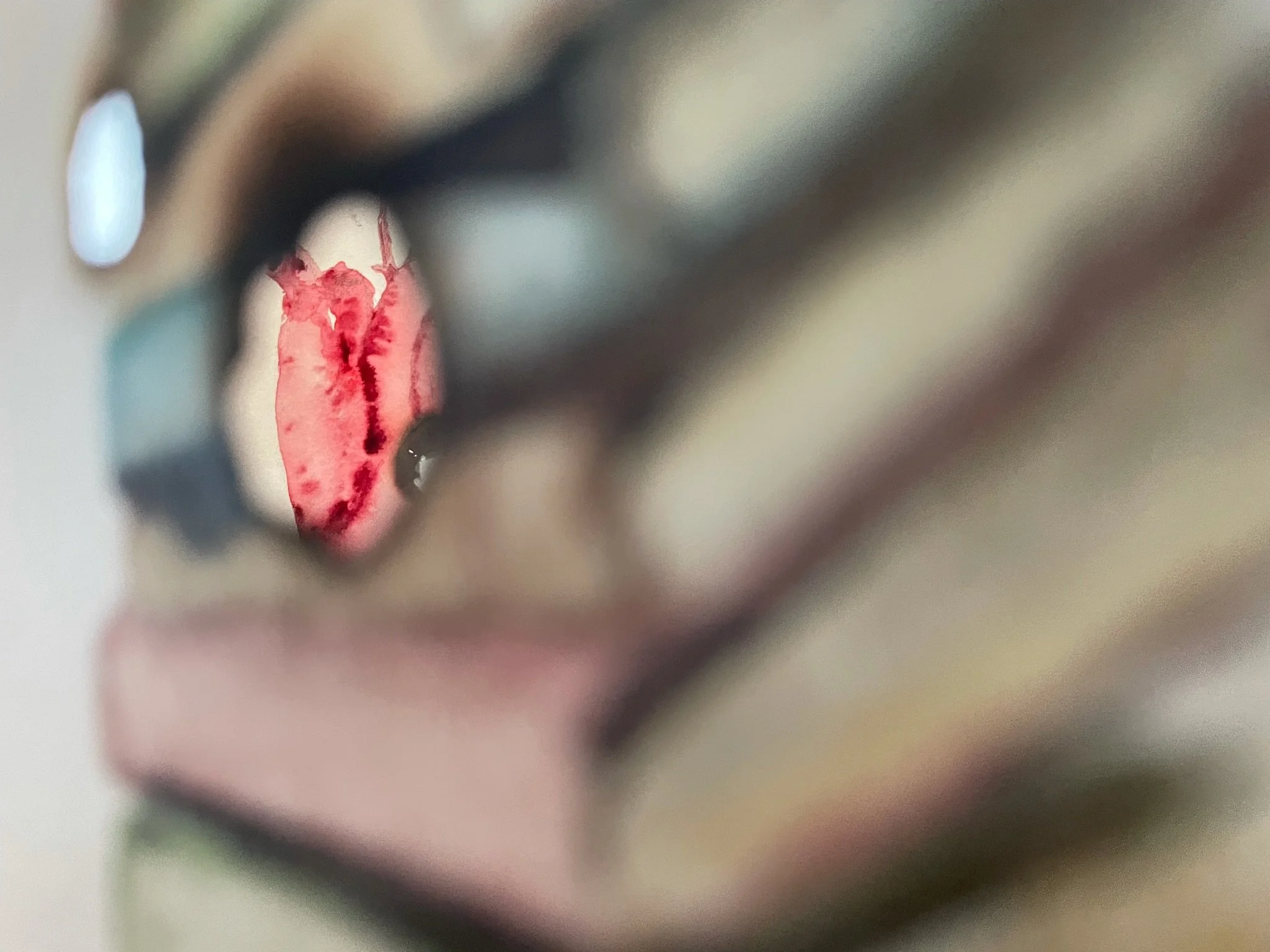

Image from Beaver Bentwood Box by Robin Roberts
Image from Burned Out Again by Carrie Jenkins, photography by Jonathan Ichikawa